AutoMem on the Neutral Benchmark: The Numbers That Hold Up
AutoMem's results on the neutral Agent Memory Benchmark — graceful BEAM scaling to 10M, ~3.9k context tokens, and the conversational-recall gap, stated plainly.
The 0.16 post ended with a promise: stop quoting own-harness, own-judge numbers, submit AutoMem to the neutral Agent Memory Benchmark, and stand behind *those* results — same answerer, same judge, same grader as everyone else. That run is done. Here's what it returned, win and loss both.
The short version
- AutoMem ran on the neutral AMB — Gemini answerer, Gemini judge, single-query RAG mode. Same harness everyone else gets graded by. The judge confound from the 0.16 post is gone.
- On BEAM — the one apples-to-apples axis — AutoMem beats Honcho at every tier, and the margin *grows* with scale: +4.5pp at 100k, +0.7 at 500k and 1M, +16.8pp at 10M.
- It degrades gracefully. ~67.5% at 100k down to ~57.4% at 10M — a 10-point slide across a 100x bigger haystack. Honcho holds flat then falls off a cliff: 63.0% → 40.6%.
- It feeds the answerer ~3.9k context tokens at every scale. The board's leader feeds 17–27k on BEAM. That's architectural, not a hardware accident.
- The honest other half: on conversational recall, AutoMem trails. Hindsight beats it on all three Core-3 splits. The strength here is large-context scaling, not verbatim chat recall.
- You can run the whole thing yourself. One command per split, no embedding API keys, outputs committed. The provider PR is up at vectorize-io and under review.
What the neutral harness actually fixes
The 0.16 post had one number that reframed everything: the *same* AutoMem answers scored 82.0% under a gpt-5-mini judge and 70.25% under a gpt-5 judge. A ~12-point swing from grader strictness alone — no memory change, no retrieval change. That's why internal numbers can't go on a leaderboard and mean anything against someone else's. Every published score is entangled with whatever judge produced it.
The neutral Agent Memory Benchmark (AMB, from vectorize-io) removes that confound by fixing the parts a provider is otherwise free to vary. One answerer — gemini-3.1-pro-preview. One judge — gemini-2.5-flash-lite. Single-query RAG mode. Every provider feeds its retrieved context into the *same* answerer and gets graded by the *same* judge. The only thing that changes between runs is the memory system. That's the whole point: hold the grader constant, and the score finally measures retrieval architecture instead of judge mood.
The provider config was deliberately lean, so the result reflects AutoMem's *defaults*, not a tuned demo. Self-spinning Docker stack — FalkorDB plus Qdrant — booted by the harness. FastEmbed-local bge-base-en-v1.5, 768 dimensions, no embedding API keys. Enrichment off (ENRICHMENT_ENABLED=false). Run name automem-sub. Nothing on the answer side is tunable here; the provider brings retrieval and the harness brings the rest.
One caveat stated before any number, not buried under it: the competitor scores named below come from AMB's external_results.json — published or self-reported, with source attribution — not re-run through this Gemini harness. That matters per-benchmark, and it's flagged below where it changes how much weight a comparison carries.
The result: BEAM scaling, and the 10M centerpiece
BEAM is the axis that holds up for comparison. It's the one benchmark where AutoMem and the published competitors ran *the same benchmark under the same neutral harness* — apples-to-apples, not directional. (BEAM scores are rubric-mean: each item graded 0 / 0.5 / 1 and averaged, so it's a different scale than the pass/fail Core-3 benchmarks. Don't cross-compare the raw percentages between the two families.)
Here's the curve, AutoMem versus Honcho, across the four BEAM tiers:
- 100k (averaged over 3 reproduction runs, spread 1.8pp): AutoMem 67.5% vs Honcho 63.0% — +4.5pp
- 500k (±2.8, n=700): AutoMem 65.6% vs Honcho 64.9% — +0.7pp
- 1M (±2.7, n=700): AutoMem 63.8% vs Honcho 63.1% — +0.7pp
- 10M (±5.5, n=200): AutoMem 57.4% vs Honcho 40.6% — +16.8pp
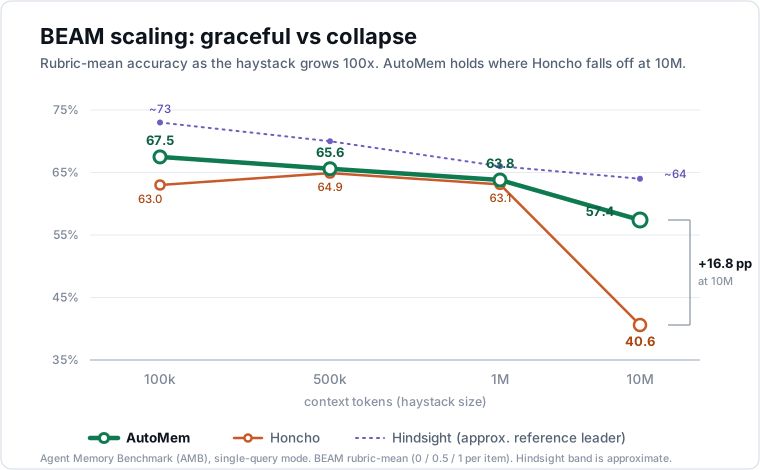
Read the shape, not just the points. AutoMem beats Honcho at every tier, and the lead widens exactly where it's hardest to fake. From 100k to 10M — a 100x increase in haystack size — AutoMem slides from 67.5% to 57.4%. That's a 10-point cost for a hundredfold harder problem. Honcho holds flat through 1M and then drops off a cliff at 10M: 63.0% down to 40.6%, a 22-point collapse over the same range.
The 10M tier is the most defensible one. At ten million tokens of context, stuffing the window is *physically impossible* — no model in this harness has a 10M context to dump the haystack into. So whatever score comes out at that tier measures retrieval architecture and nothing else. AutoMem lands ~57% where Honcho breaks to ~41%. That gap isn't a context-window advantage — there is no context window big enough to be one here. It's the retrieval doing the work.
Precision about the standings is the entire reason for this run. AutoMem is not the BEAM leader. Vectorize's own Hindsight holds a ~73–64% band across the full curve and sits above AutoMem at every tier (~73% at 100k, ~64% at 10M). AutoMem is a clear #2 on BEAM — above Honcho, below Hindsight. The honest placement: second, by a clear margin over third.
The honest other half: conversational recall
Now the part that doesn't get slid past. BEAM is large-context scaling. The other half of AMB is Core-3 — locomo, longmemeval, personamem — and those measure conversational, verbatim recall. There, AutoMem trails.
The right yardstick for Core-3 is Hindsight, because Hindsight also ran the neutral harness — a clean comparison, same answerer and judge. AutoMem trails it on all three:
- locomo/locomo10: AutoMem 85.1% (±1.8, n=1540) vs Hindsight 92%
- longmemeval/s: AutoMem 74.4% (±3.8, n=500) vs Hindsight 94.6%
- personamem/32k: AutoMem 76.1% (±3.4, n=589) vs Hindsight 86.6%
That longmemeval gap — 74.4 against 94.6 — is the one that stings, and it stays in plain sight. (Honcho self-reports higher on locomo and longmemeval too, but those come from *Honcho's own harness*, so they carry exactly the answerer-and-judge confound AMB exists to remove — directional only, not a clean head-to-head. Hindsight is the comparison that holds.)
The read that fits the data: AutoMem's strength is large-context retrieval at scale, not verbatim conversational recall. Could be the architecture — graph plus vector tuned for finding the needle in a huge haystack rather than reconstructing a chat transcript line by line. Could be the lean config — FastEmbed 768d with enrichment off is a deliberately modest retrieval surface for a conversation-heavy split. Probably some of both. The BEAM win isn't a general win. It's a *scaling* win with a real conversational-recall gap attached.
Efficiency: ~3.9k tokens, every scale
This part holds up regardless of which benchmark matters most, and it may be the most striking number in the run. AutoMem feeds the answerer ~2.6–4.8k context tokens at every scale — reported as the mean, matching the board's avg_context_tokens metric. Concretely, across BEAM: 3,842 tokens at 100k, 3,929 at 500k, 3,900 at 1M, 3,932 at 10M. The haystack grows by 100x; the context handed to the answerer stays flat around 3.9k.
The board's leader feeds 17–27k context tokens on BEAM to get its scores.
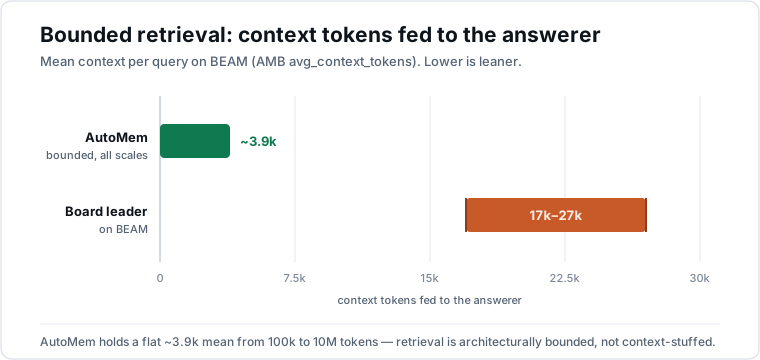
That's a 4–7x difference in what the answerer has to read, and it's architectural, not hardware-dependent. Whatever box runs it, AutoMem's retrieval narrows the candidate set hard before the answerer ever sees it. Every token the answerer doesn't have to read is latency unpaid and budget unspent, on any model, on any host. For a system that sits in the hot path of an agent loop, tokens-per-answer is the metric to optimize first, and AutoMem already leads it by a wide margin.
(A note on speed, since someone always asks: these runs were sub-second P50 on most tiers — 127–451 ms — and ~1.7s P50 at 10M. That's one machine's hardware, reported for these runs only. It is not a cross-system axis. Different providers ran on different boxes, so "Nx faster than X" is a claim that can't be made here and won't be. The 10M *mean* is roughly 2.2x its median because an unrelated local process was hammering the host CPU during that run — prefer the P50. Accuracy is unaffected: retrieval is deterministic; only the timing is load-sensitive.)
Run it yourself
The reason this post exists instead of a screenshot is that you can reproduce all of it.
- The
outputs/are committed and public — the raw per-item results, not just summary numbers. AUTOMEM_REPRODUCE.mdgives you one command per split.- The provider self-spins its full stack — FalkorDB, Qdrant, FastEmbed — with no embedding API keys. You don't need an OpenAI or Voyage key to reproduce a single number above.
This launch publishes the public image (ghcr.io/verygoodplugins/automem:amb-v1) and the provider PR to vectorize-io's AMB repo. Precise status framing: submitted to the neutral board, PR under review. Not "live on the leaderboard." When the PR merges, that sentence changes — until then, the honest word is *submitted*. What's possible today: clone it and run the harness yourself, which is the part that actually matters.
Start at the benchmarks page for the full head-to-head table — every system, every tier, with source attribution on the external numbers. The comparison is narrated here on purpose, with the grid kept on that page rather than pasted into a blog post.
What's next
The Core-3 gap is the roadmap. The 0.16 post already found that AutoMem's failures were mostly *reasoning over a retrieved memory*, not failing to retrieve it — and longmemeval is exactly the split where that bites hardest. So 0.17 aims at conversational and temporal recall: closing the distance to Hindsight on the splits where AutoMem currently trails, without giving back the BEAM scaling or the token efficiency. That's the needle to thread.
And once the vectorize-io PR merges, "submitted" becomes "on the board" — and the whole curve gets re-run under the same neutral harness to confirm the numbers held. Same grader, every release. That's the bar now.
Caveats, up front
- BEAM is the only apples-to-apples axis. Same benchmark, same neutral harness, versus published competitors. Trust those comparisons most.
- Core-3 competitor numbers split two ways. Hindsight ran the neutral harness (clean). Honcho's Core-3 figures are self-reported on its own harness (directional only — they carry the judge confound AMB removes).
- AutoMem is #2 on BEAM, not #1. Hindsight leads the curve; AutoMem sits clearly above Honcho and clearly below Hindsight.
- AutoMem trails on conversational recall. locomo 85.1 vs 92, longmemeval 74.4 vs 94.6, personamem 76.1 vs 86.6. The win is scaling, not chat recall.
- Latency is single-machine only. Never read it as a head-to-head; different hardware per provider.
- Status is "submitted, PR under review," not live on the leaderboard, until the PR merges.
The 0.16 post called the neutral-harness numbers the ones worth standing behind. These are them — a #2 on large-context scaling, a genuine gap on conversational recall, and a token-efficiency story that holds on any hardware. Win and loss, same page. That's the honest version, which is the only one worth shipping.

Jack Arturo
Developer, open source advocate, and builder of AI tools. Creator of AutoMem, WP Fusion, and EchoDash.