AutoMem 0.16: Correctness Over Knobs
What shipped in 0.16, the four recall-tuning knobs built and deliberately left off, and why the internal benchmark numbers aren't comparable to anyone else's yet.
AutoMem 0.16 shipped this week — 63 commits and about 5,000 lines of server code since 0.15.2. The most interesting decision in the release was the half that stayed turned off.
The short version
- Recall stops surfacing dead memories. Superseded and invalidated facts are filtered by default now.
- A new retrieval channel (metadata sidecar) that's on out of the box.
- A stack of scoring correctness fixes — keyword normalization, summary hydration, an embedding bug that was quietly storing garbage vectors.
- Bulk associations and an admin backup endpoint — new API surface.
- Four recall-tuning knobs built, measured, and left OFF — because the data said to.
That last one is the real story. These aren't half-finished features. They're finished features that lost their A/B.
Why this release exists
0.15 got AutoMem to "good enough to trust." 0.16 was supposed to be the recall-quality release — tighten ranking, stop stale results from winning, make the newest version of a fact beat the stale one.
Some of that shipped and is live. Some of it got chased, measured, and abandoned. Both halves are below, with the numbers behind each.
First, a caveat that shapes everything: there's no clean "0.15 → 0.16 = +X%" number here. The recall A/B lab had a config-plumbing bug for most of its life — the env overrides never reached the container, so every "comparison" was secretly comparing two identical configs. It's been rebuilt. The comparisons below come from the rebuilt lab; the historical ones were thrown out. Stating that is cheaper than quoting a number that doesn't hold up.
What's live by default
Recall ignores dead memories
The biggest behavior change. Before 0.16, if you stored a fact, then superseded it, recall could still hand back the old one. Now /recall defaults to current_only — expired, not-yet-valid, invalidated, and evolved-into memories are suppressed unless you explicitly ask for history (current_only=false).
Test process: a targeted eval (run_current_state_recall_eval.py) seeds an isolated set of current/stale/future/superseded memories, calls /recall with state_debug=true, and scores both what came back *and* what got correctly suppressed.
Result: 6/6 scenarios pass — stale and future memories suppressed, invalidated replaced by current, and CONTRADICTS deliberately *preserved* (a contradiction isn't a stale fact; you want both). Plus 15 focused regression tests covering temporal validity, INVALIDATED_BY/EVOLVED_INTO suppression, and tag-filtered replacement injection. This is the same direction the forgetting-aware benchmarks (FAMA, out of ACL 2026) are pushing the whole field — don't reward a system for confidently recalling something that's no longer true.
A new retrieval channel
0.16 adds a metadata sidecar search path — candidates admitted via metadata matches, weighted at 0.35 alongside vector and keyword. On by default (RECALL_METADATA_SEARCH_ENABLED=true). More ways to surface the right memory, especially when the match lives in structured metadata rather than the content body.
The unglamorous correctness fixes
No A/B for these — they're bugs, validated by the test suite, not preferences to be tuned:
- Keyword scores normalized into the 0–1 range. Graph keyword hits were escaping the component range and distorting the weighted sum. Everyone's rankings were subtly off; now they aren't.
- Semantic recall summaries hydrate. Vector hits return their summaries instead of dropping them.
- Embedding batch fallback. The batch store path could fall back to placeholder (hash-based, semantically meaningless) vectors instead of retrying real embeddings — memories that looked stored but were unsearchable. Fixed to exhaust real embeddings first.
- Entity extraction stopped over-rejecting real people, code tools, and event categories (a 669-line rewrite of the entity-quality path). Cleaner entity tags for everyone, since enrichment runs on by default.
New capabilities
- Bulk associations —
POST /associatenow takes up to 500 associations in one call, instead of one HTTP round-trip per edge. - Admin backup endpoint —
/backupplus a real backup module behind an admin token. - `state_mode=current|history` recall alias, configurable recency decay window/curve, cluster threshold/size env vars, and the MCP detailed-recall format now surfaces stored metadata and
updated_at.
The knobs built and left off
Here's where the testing earned its keep. Four levers got built, measured on a 10,107-memory production clone and a judged BEAM 100K run, and shipped inert:
| Knob | What it'd do | What the data said |
|---|---|---|
|
| Down-weight off-topic high-importance memories in tag-scoped recall (issue #130) | Gate at 0.0 / 0.15 / 0.40 → "preserve" score flat at ~0.983. No measured win. |
|
| Re-rank so newer facts beat older ones on temporal queries | −0.5pt on judged BEAM (82.00% → 81.50%) |
|
| Cap the tag-score denominator to fix query-length bias | Cap 2/3/4 → −14 / −7 / −4pp Recall@5 (200 queries) |
|
| Fold consolidation-decay relevance into scoring | 0.0 by default = literal no-op; never beat baseline |
The recency one is the trap worth naming. "Prefer the newest version of a fact" *sounds* like an obvious win. On a query set with real temporal intent, it probably is. On the broad BEAM mix, it cost half a point — most questions don't have temporal intent, so the re-rank is noise more often than signal.
So recency_bias=auto stays in the box as a per-request option and a benchmark setting, not a default. Flipping any of these to on now would be shipping vibes. The bar is a judged A/B that beats the all-off baseline, and none of them cleared it yet.
Knowing *not* to flip a knob is a result. It's just not the one that feels like progress.
The methodology problem behind the numbers
Here's the number that reframes all of this.
Same AutoMem. Same answers. Same BEAM 100K question set. Scored by two different judges:
- Under a gpt-5-mini judge: 82.0%
- Under a gpt-5 judge: 70.25%
A ~12-point swing from judge strictness alone. Not a memory change. Not a retrieval change. Just a stricter grader.
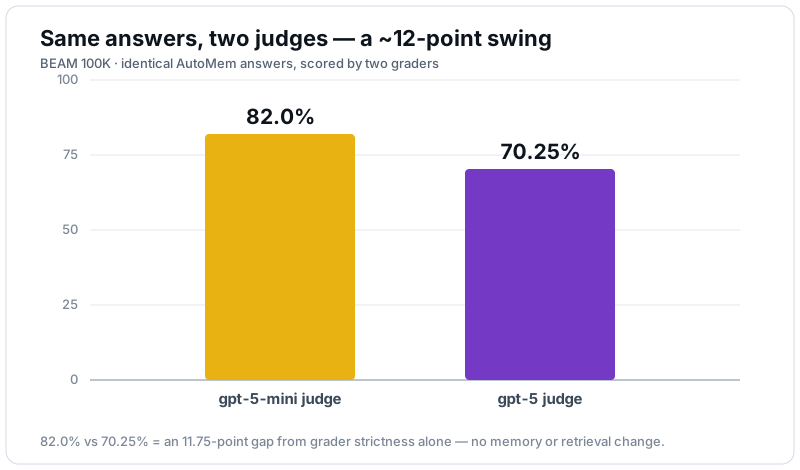
That's the whole reason own-harness, own-judge numbers aren't comparable to anyone else's — Hindsight publishes ~73–75% at the 100K tier, mem0 and Zep publish their own, and every one of those is entangled with whatever judge they ran. AutoMem's native runner beats the mem0-shim baseline at the same model (82.0% vs 76.25%, both gpt-5-mini) — a ~6-point edge from AutoMem's own chunking and /recall over the mem0 wire contract — but that number can't go on a leaderboard and mean anything.
So the next step wasn't a config change. It was submitting AutoMem to the neutral Agent Memory Benchmark — standardized Gemini answerer, standardized Gemini judge, results by PR. Same grader as everyone else. That run is done, and its numbers are the ones worth standing behind: the neutral AMB results are here .
Where the real bottleneck turned out to be
One more finding from a 500-question LongMemEval pass reframed the roadmap. Overall: ~87% answer accuracy, ~97% recall@5. Break the 65 wrong answers down by cause:
- 54 had the right session retrieved at recall@5 — and still got answered wrong.
- 11 were actual retrieval misses.
pie showData
    title 65 wrong answers — where they failed
    "Right session retrieved, still answered wrong" : 54
    "Actual retrieval miss" : 11
The memory was there 83% of the time it failed. The bottleneck isn't finding the right memory — it's reasoning over it once it's found, especially temporal conflicts and preference updates (single-session-preference was the worst category at 56.67%). That's not a retrieval-weights problem. That's issues #158 and #159, and it's where 0.17 goes.
What's working, what isn't, what's next
Working: state-aware recall, the new metadata channel, the correctness fixes. AutoMem at its all-off defaults scores 82.0% on judged BEAM 100K — but that's under an in-house gpt-5-mini judge, so read it as directional: above the mem0 shim, in the neighborhood of Hindsight's published 100K tier, not a leaderboard claim. The defaults are good, and they stay untouched.
Not working yet: preference and temporal-conflict reasoning. Retrieval finds the fact; the answer step fumbles it.
Next: the neutral AMB run landed — real comparable numbers are in the results post — and 0.17 is aimed squarely at the retrieved-but-wrong failure mode.
Caveats, up front
- No clean 0.15→0.16 delta — the old A/B lab was a no-op, stated plainly rather than fabricated.
- The internal benchmark numbers above use an in-house judge. Treat them as directional until the neutral-harness run lands.
- BEAM 100K is an easier tier than mem0's published 1M/10M settings. Different tier, different number.
0.16 is mostly correctness and capability, with a deliberate decision to leave the tuning alone until the evidence shows up. That's not the flashy version of a release. It's the honest one.

Jack Arturo
Developer, open source advocate, and builder of AI tools. Creator of AutoMem, WP Fusion, and EchoDash.